
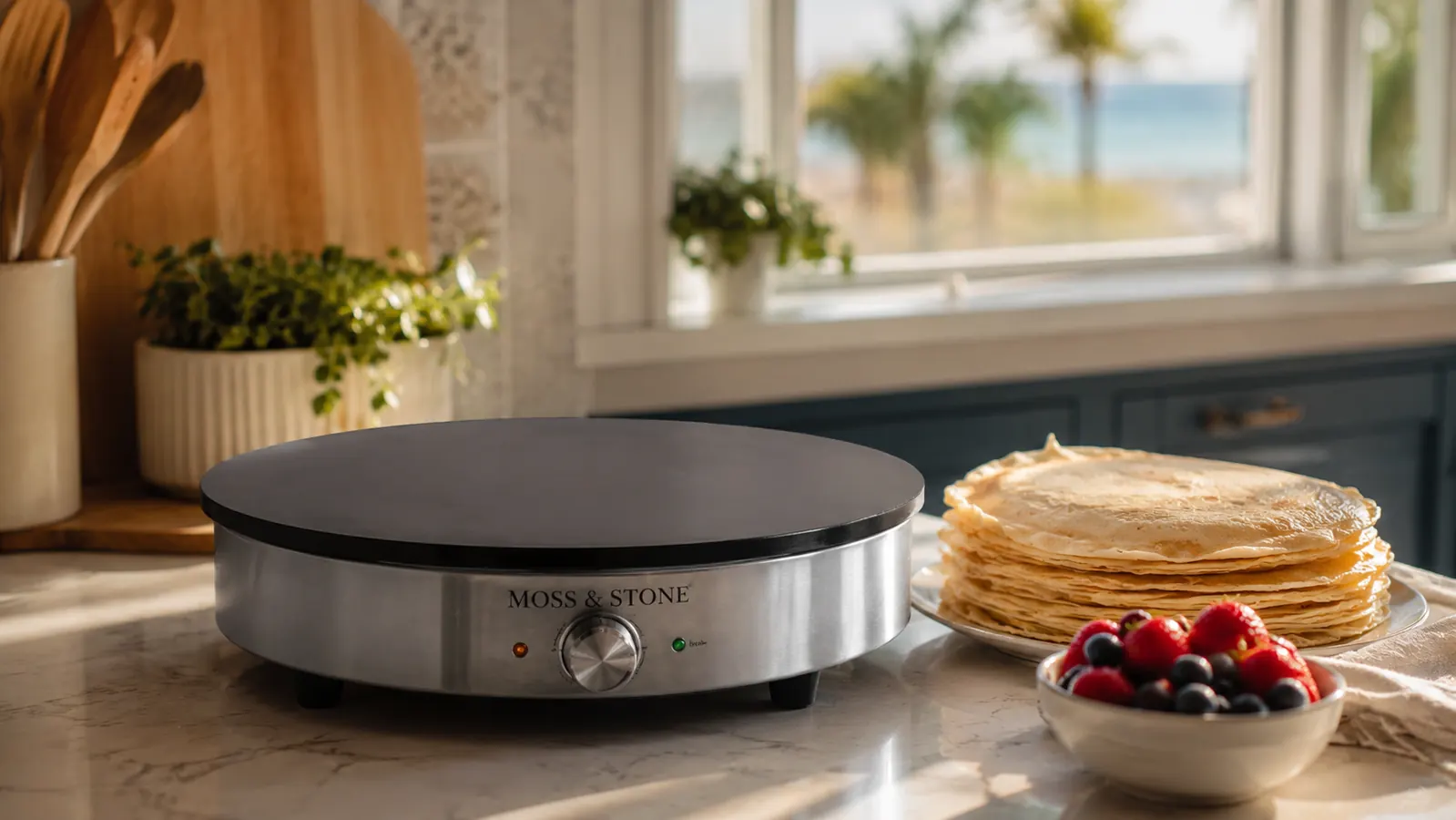
The first Sunday I plugged in the Moss & Stone crepe maker, I was mostly trying to fix a problem with a regular skillet. I'd been attempting crepes for Carol on and off for years, and every single time the first two came out too thick, torn, or stuck to the pan no matter how much butter I used. A friend at church mentioned she'd switched to one of these flat electric crepe griddles, and six months and roughly twenty Sunday brunches later, I understand exactly why. This little black disc has become the reason our grandkids ask to sleep over on Saturday nights, because they know what's coming in the morning.
I'm 68, retired, and I'm not a chef by any stretch. What I am is the guy in the family everybody calls when they're deciding what to buy for the kitchen, so when I tell you I bought the Moss & Stone 8 inch electric crepe maker with my own money and I'd do it again today, that means something around here. This is what half a year of actual weekly use looks like, not a first impression out of the box.
The Quick Verdict
A genuinely simple gadget that turned thin, even crepes into a repeatable Sunday routine, with a couple of real annoyances that keep it from being perfect.
Amazon Check Today's Price →Still Deciding? Here's What Today's Price Gets You
The Moss & Stone crepe maker is an 8 inch nonstick dipping-plate griddle with auto shut-off and a simple on/off switch, no dials to fuss with. Check today's price before you decide.
Amazon Check Today's Price on Amazon →How I've Used It
Our routine hasn't changed much since week one. Carol mixes the batter Saturday night and lets it rest in the fridge overnight, which she swears makes a difference and I've stopped arguing with her about it. Sunday morning, I set the Moss & Stone on the counter, flip the switch, and by the time it's hot I've got the dipping plate ready and a stack of plates lined up for whoever wanders into the kitchen first, usually one of the grandkids still in pajamas.
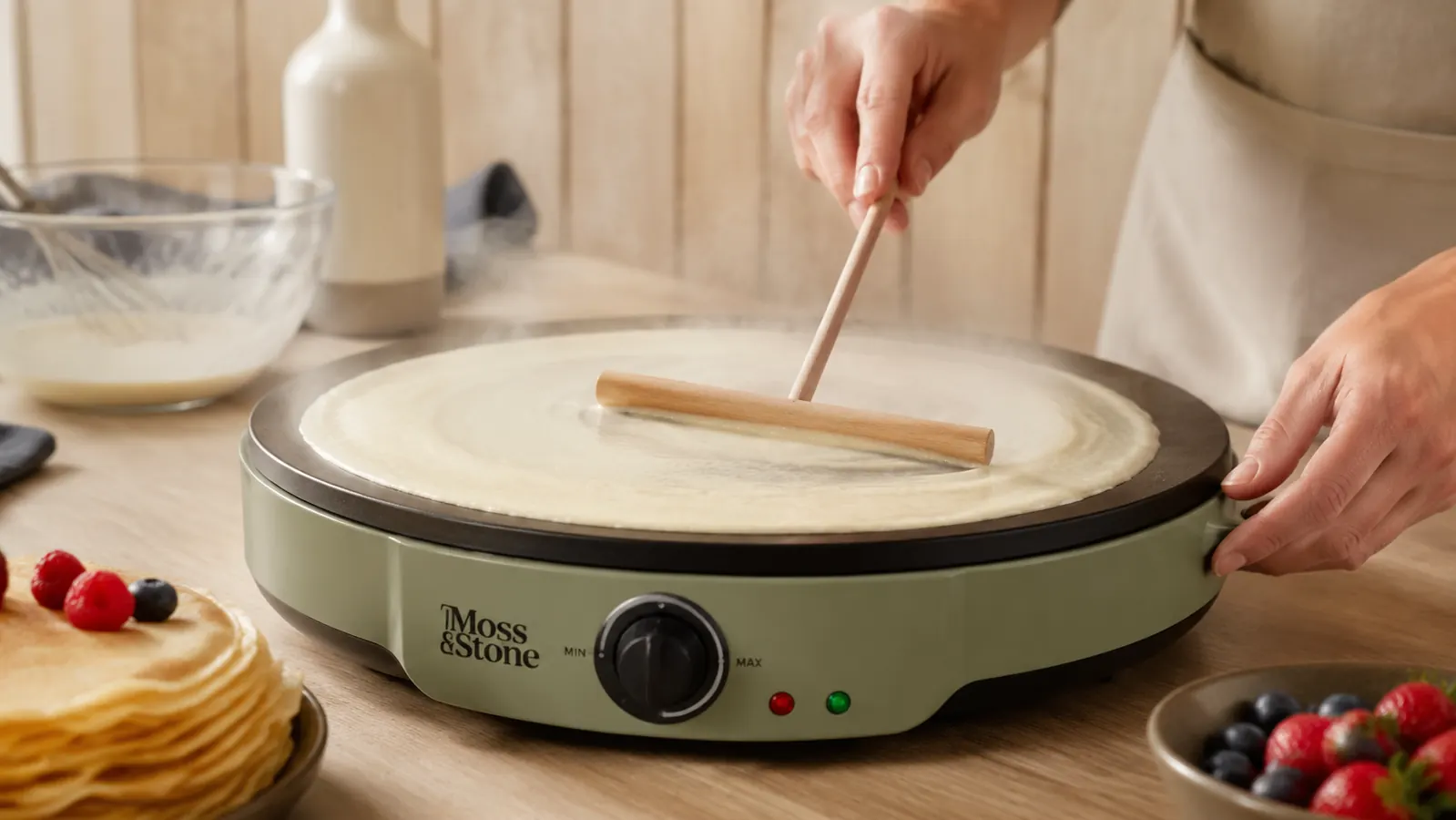
The way this one works is different from a regular pan. You dip the round hot plate face-down into a shallow bowl of batter, then flip it back over onto the base and let it cook for maybe 45 seconds. It sounds fussy the first time you read the instructions, but by the second Sunday I had it down, and now I can turn out a crepe every minute or so once the rhythm gets going.
Cleanup is the real test of whether a gadget stays on the counter or ends up in a cabinet forever, and this one has held up fine on that front. The nonstick dipping plate wipes clean with a paper towel most Sundays, and I've only had to actually wash it with soap and water a handful of times over six months. Carol likes that it doesn't take up much room either. It's about the footprint of a large dinner plate, so it lives on a shelf in the pantry between uses instead of cluttering the counter.
What I didn't expect going in was how much of a production the whole morning would turn into once the grandkids caught on. Megan's two youngest have their own topping stations now, one for cinnamon sugar and one for strawberries and whipped cream, and I've learned to just make a bigger batch of batter than I think we need, because a Moss & Stone crepe never seems to make it past the first bite before somebody's asking for another one.
Getting the Batter Thin Enough Was the Real Learning Curve
The Moss & Stone crepe maker itself is simple. The learning curve is really about the batter and the dip, not the machine. The first two Sundays, my crepes came out a little thick in the middle because I wasn't dipping the plate evenly, tilting it too much on one side. Carol figured out before I did that you want the batter thin, almost like heavy cream, and you want to dip straight down and lift straight up without swirling the plate around.
Once we adjusted the batter consistency, the results turned around fast. This crepe maker doesn't have a temperature dial, just a single on/off switch, and I was skeptical about that at first coming from the Cuisinart fondue pot we've had for years with its adjustable dial. But the fixed heat setting on this thing is actually well suited to crepes specifically, since you're not trying to hold a simmer or manage different foods at different temperatures. It gets hot, stays hot, and the auto shut-off kicks in if you walk away and forget about it, which I've done exactly once when the phone rang mid-brunch.
The 8 inch size has turned out to be right for our family. It's enough surface for a proper crepe you can fill and roll without it being so big that flipping becomes a two-hand operation. For four grandkids plus Carol and me, I can usually get through a full batch of batter in about 25 minutes once everything is warmed up and the assembly line gets moving.
Six Months of Sunday Brunches
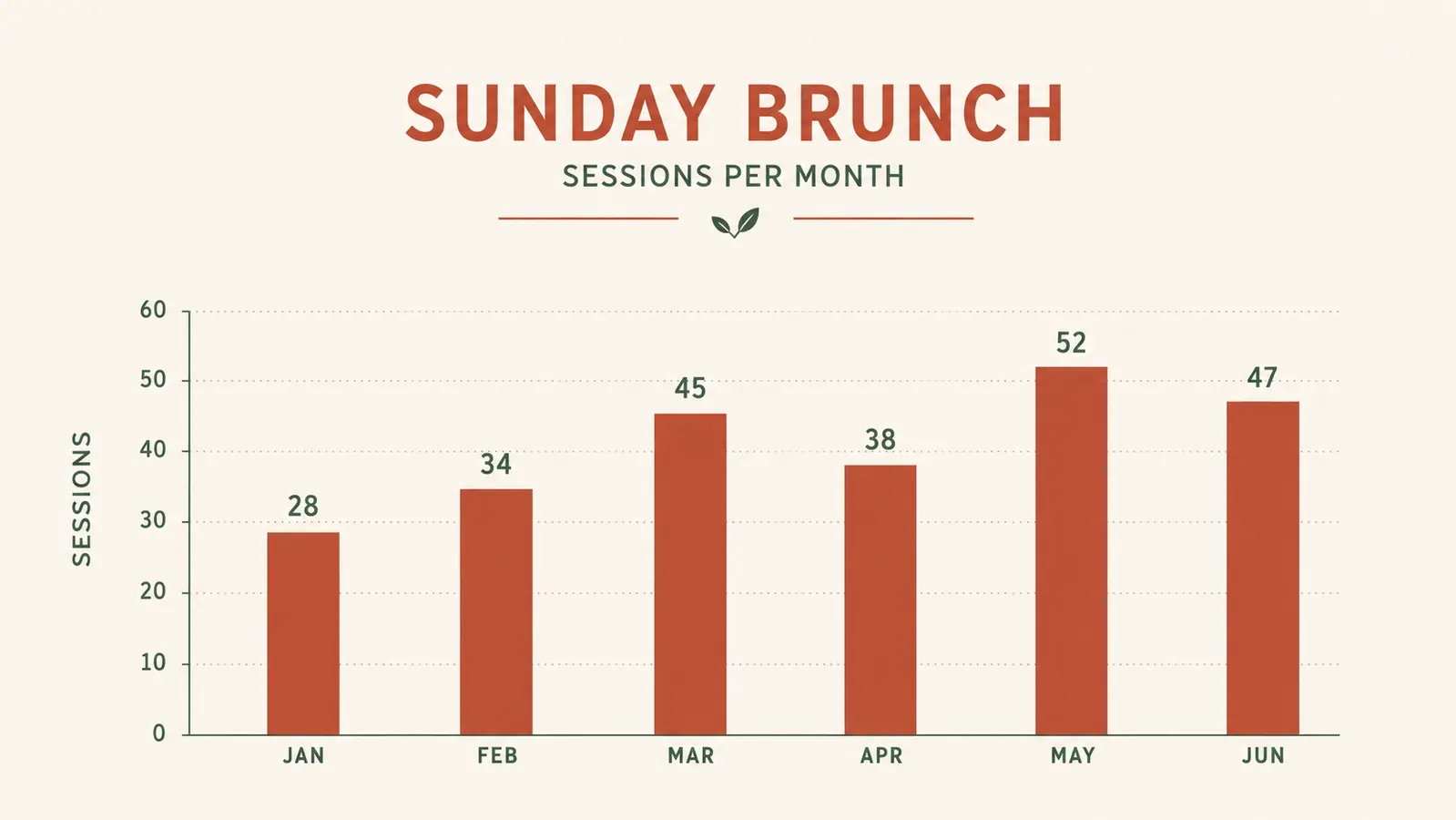
The real test of any kitchen gadget in my house isn't the first week, it's whether it survives being used nearly every weekend for half a year straight. This one has. I'd estimate we've done somewhere around twenty separate crepe mornings since we bought it, some just for Carol and me, most with at least a couple of the grandkids at the table. It still heats up the same way it did the first Sunday, no noticeable slowdown.
The nonstick surface is the piece I watched most closely, since that's usually where a budget gadget like this starts to fail. Six months in, it still releases crepes cleanly without a fight, though I'll admit it's not quite as slick as it was the very first few uses. I credit some of that to us being careful, we only ever use the wooden spreader tool that came with it or a silicone spatula, never metal, when we're loosening an edge.
The base and cord have held up fine with no issues. The one thing I have noticed after this many uses is that the power light dims a little compared to when it was new, which doesn't affect how it cooks, just something I noticed. Looking back over twenty-some brunches, the results have been consistent. I can count on one hand the number of crepes that tore badly enough to toss, and most of those were my fault for rushing the flip before it was ready.
Danny came down with his family over Easter weekend and put the Moss & Stone through its toughest test yet, three back-to-back batches for nine people over two mornings. It didn't miss a beat, though I did have to let it cool for a few minutes between batches so the dipping plate wasn't holding too much residual heat, which was the only time in six months I felt like I was pushing it past what it's really built for.
Where It Falls Short
Nothing is perfect, and I'd rather tell you the annoyances now than let you find them after buying it. The biggest one is the lack of a temperature control. For crepes specifically it works fine, but Carol tried using it once to make a thin egg wrap for a low-carb breakfast and it ran too hot for that, scorching the edges before the center set. If you're hoping to use this for more than crepes and thin pancakes, that single fixed setting is going to limit you.
The dipping process itself takes some getting used to, and it's genuinely awkward the first several tries. You need a bowl wide and deep enough to fully submerge the plate, and ours is a hair too shallow, so I have to tilt the bowl slightly every time, which means occasional batter drips on the counter. I've since found a wider pie dish that works better, but it wasn't obvious from the instructions that bowl choice would matter this much.
The handle also gets warmer than I expected during a long batch. It's not dangerous, but after the fifteenth or twentieth crepe in a row, I notice the heat through the handle more than I did on crepe number two. I've started using a folded dish towel for the last few of any big batch, which solves it, but it would be nice if Moss & Stone insulated that handle a bit better.
Why I Didn't Go With a Traditional Crepe Pan
Before I bought the Moss & Stone, I spent a couple of weeks looking at both traditional stovetop crepe pans and other electric griddles, including CucinaPro, since that brand shows up constantly in searches. I actually wrote up a full side-by-side comparison if you want the details, but the short version is that a stovetop pan puts the whole thickness and evenness question back in your hands, and after years of failing at that with a regular skillet, I wanted the dipping-plate method to take that variable out of the equation.
What tipped it toward Moss & Stone specifically was the price relative to what I was asking it to do. I wasn't trying to replicate a restaurant kitchen, I was trying to make Sunday mornings easier on myself and reliable enough that Carol's thumb, which gets stiff some mornings from her arthritis, wasn't doing any extra work flipping a heavy pan. The dipping plate is light and the whole unit is easy for her to handle even on days her hands are bothering her more than usual.
I also asked around and heard from two other folks in town who'd owned a similar dipping-plate crepe maker for a couple of years without complaints, which mattered more to me than a stranger's five-star review online. Six months in, I don't think much anymore about what we spent on it. I think about how many Sunday mornings it's given us with the grandkids actually sitting still at the table instead of scattered around the house.
I've also come around on the idea that this isn't meant to replace a full griddle or a regular skillet, and once I stopped expecting it to, my opinion of it went up. It does one job, a thin even crepe, better and more consistently than anything else in our kitchen has managed, and for a Sunday morning gadget that's exactly what I wanted from the Moss & Stone in the first place.
What I Liked
- Dipping-plate method produces thin, even crepes without the guesswork of a regular skillet
- Simple on/off switch with auto shut-off, nothing complicated to learn
- 8 inch size is right for a family of four to six without being unwieldy
- Compact enough to store on a shelf between uses
- Light enough for hands with arthritis or limited grip strength to manage comfortably
Where It Falls Short
- No temperature control, so it's really only suited to crepes and thin batters, not eggs or heavier pancakes
- Dipping technique takes a few tries to get right and needs a wide, deep bowl
- Handle gets noticeably warm partway through a big batch
- Nonstick release isn't quite as slick as it was in the first few uses
It's not a fancy gadget. It's just the reason my grandkids show up in their pajamas on Sunday morning instead of sleeping in.

Who This Is For
If your family likes a reason to slow down on a weekend morning, this earns its keep fast. It's also a solid fit for anyone who's tried and failed at crepes with a regular pan, since the dipping-plate design removes most of the skill the traditional method demands. Carol and I have gotten more mileage out of this than almost anything else we've bought for the kitchen this year, and it's become one of my go-to gift recommendations for new parents or anyone who hosts a regular brunch.
It's also worth a look if someone in your house deals with arthritis or a weaker grip. Carol's thumb gives her trouble some mornings, and this is one of the few kitchen tools I've bought lately that she can use start to finish without needing me to take over partway through.
Who Should Skip It
If you're hoping for a multi-purpose griddle that can handle eggs, thick pancakes, or grilled cheese, this isn't built for that job and you'll be disappointed the first time you try. And if you're only going to make crepes once or twice a year for a special occasion, a cheap stovetop crepe pan will do that job for less money without taking up shelf space the other fifty weeks of the year. This one is built for a family that wants crepes often, not once in a while.
Ready for Your Own Sunday Brunch Tradition?
After six months of weekly use, this is still what I recommend first when someone asks me how to make real crepes at home without the learning curve of a stovetop pan. Check today's price on Amazon before you decide.
Amazon Check Today's Price on Amazon →