
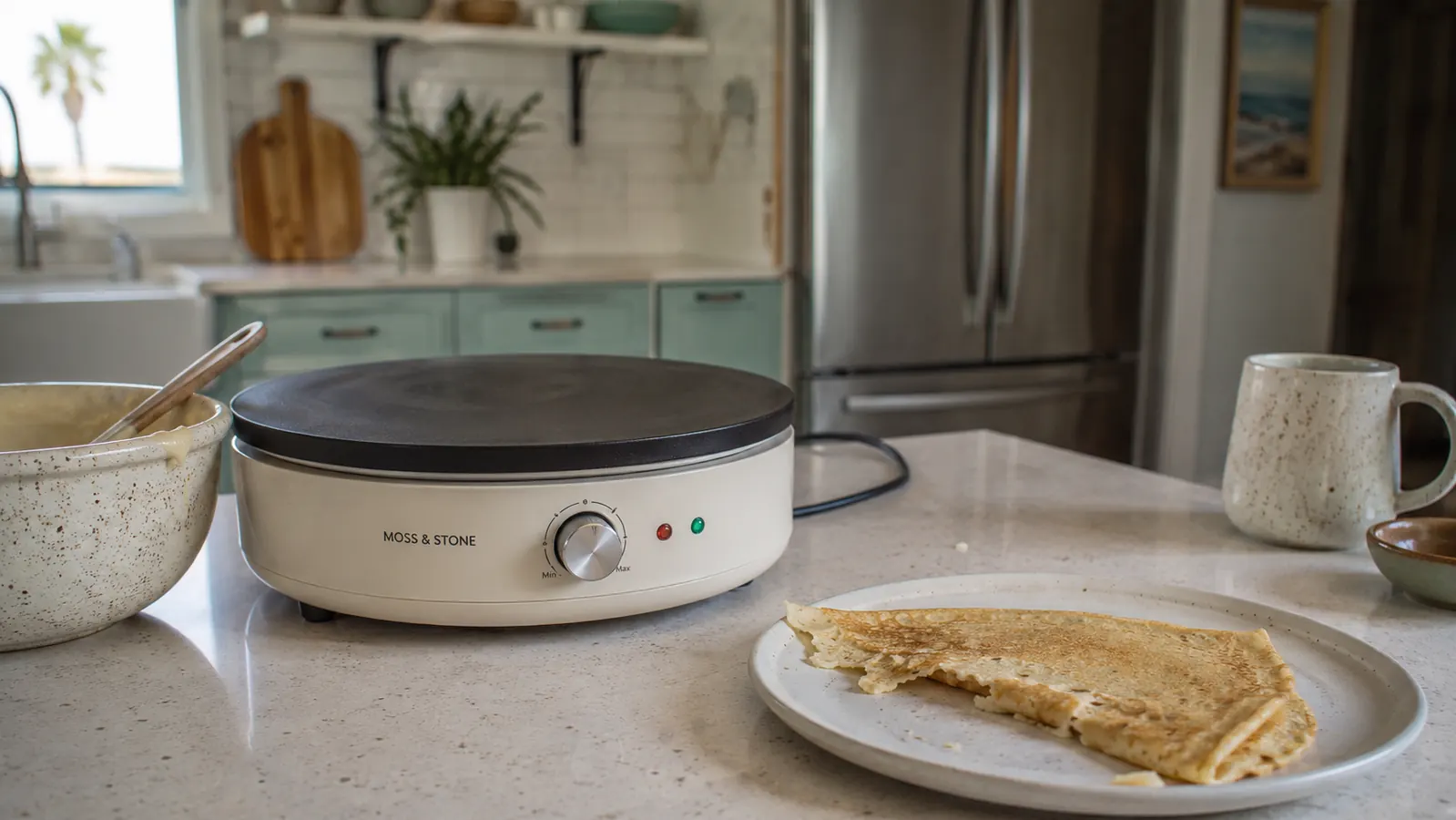
Every listing for an electric crepe maker on Amazon reads about the same. Even heating, effortless nonstick, restaurant-style crepes in minutes. Nobody selling you the thing is going to tell you what the first three tries actually look like, so I will. My first attempt at a crepe on this gadget came out half-cooked and glued to the plate in the middle, the second one tore in half the second I tried to lift an edge, and the third one I just fed to the dog out back rather than admit defeat to Carol. None of that made it into a five-star review anywhere, and it should have.
I'm not writing this to talk you out of buying the Moss & Stone electric crepe maker. Six months later, this same little machine makes it onto our counter almost every Sunday, and it's turned into the thing our grandkids ask for by name. But I think the glowing reviews do people a disservice by skipping the rough patch, so this is the honest version, warts included, of what owning it is actually like once the box is open and you're standing at the counter figuring it out for real.
The Quick Verdict
A capable little crepe maker once you get past a genuinely awkward first week, held back by a fixed heat setting and a plate that demands hand-washing every single time.
Amazon Check Today's Price →Thinking About One? Read This Part First
The Moss & Stone crepe maker is a single-purpose dipping-plate griddle. It does one thing well once you learn the motion. Check today's price on Amazon before you decide if that trade-off is worth it for your kitchen.
Amazon Check Today's Price on Amazon →How I Actually Tested This
I didn't just make crepes once and write it up. I've used this thing close to twenty separate mornings since we got it, sometimes just a small batch for Carol and me, other times a full production for four grandkids who show up hungry. I timed how long a batch actually takes start to finish, I paid attention to how many crepes tore or came out uneven each session, and I made a point of writing down what went wrong instead of just remembering the wins. That's the version I'm giving you here, not the highlight reel.
I also went back and reread the instruction booklet twice, because the first time through I skimmed it the way most people probably do, and missed a couple of details that would have saved me a rough first Sunday. If you've already bought one of these or you're about to, some of what follows might save you the same headache.
A few things about our setup matter for context. We're a family of six on a busy Sunday, Carol handles the batter, I run the machine, and neither of us is trained in anything close to professional kitchen work. If this thing only worked well in the hands of someone with real technique, I wanted to find that out and say so plainly.
Nobody Warns You How Fussy the Dipping Motion Is
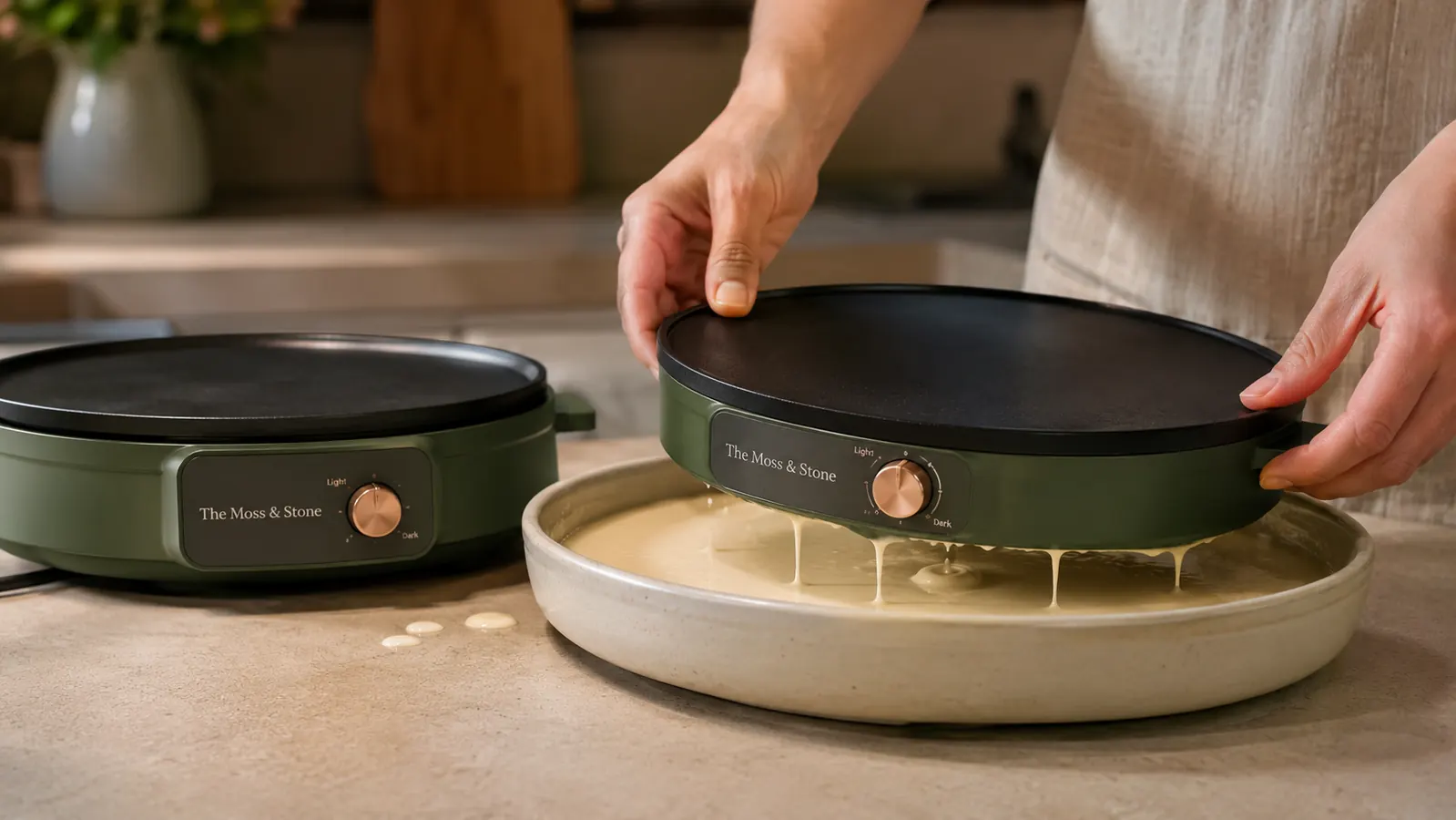
Here's what the box doesn't mention anywhere. You dip the hot round plate face-down into a shallow pool of batter, then flip it right-side up to cook, and the amount of batter that sticks to the plate depends entirely on how steady your hand is and how thin the batter actually is. My first attempt, I dipped too deep and too slow, and ended up with a crepe closer to a quarter inch thick in the center. It never fully set before the edges started to burn.
The second try I overcorrected and barely touched the surface of the batter, which gave me a crepe with holes in it, thin as tissue paper in spots and see-through by the time I lifted it off the plate. It took roughly a dozen crepes across two separate Sundays before I found the right depth and speed, a quick straight-down dip and a straight-up lift, no swirling, no hesitating halfway through.
What made this worse at first was the bowl we were using. A regular cereal bowl isn't wide enough to fully submerge the plate in one clean motion, so I was tilting and angling it, which is exactly the wrong technique. Once Carol found a wide, shallow pie dish for the batter, the whole process got easier almost overnight. That's a detail the manual never mentions, and it should.
Even after we sorted out the bowl, there was a stretch of about three Sundays where roughly one in every four crepes still came out uneven, thicker on one side than the other. I eventually traced that back to how I was holding my wrist during the dip, tilting slightly without realizing it. Once I made a point of keeping the plate perfectly level going in and coming out, that problem mostly disappeared, but it took actual attention, not something that just clicked on its own.
The Missing Temperature Dial Is a Bigger Deal Than It Sounds
This crepe maker has one switch. On or off. No low, medium, or high, and no way to back off the heat if a crepe is browning faster than you'd like. For plain crepe batter, once you know the machine, that's honestly fine, since the fixed heat is tuned reasonably well for that specific job.
Where it becomes a real limitation is the moment you try to stretch this gadget past crepes. I tried a slightly thicker batter one Sunday, hoping to get something closer to a Swedish pancake for Danny's oldest, who doesn't love the paper-thin texture, and the outside had gone dark brown while the inside was still wet. There's no way to dial that back. You either work within what this machine is built for, or you accept scorched edges as the cost of asking it to do more.
I've also noticed the plate takes noticeably longer to fully preheat than the manual suggests, closer to five minutes than the two or three it claims, especially the first crepe of any session. If you dip too early, that first one almost always comes out patchy and undercooked in spots. I've learned to just accept the first crepe of every batch as a bit of a test run rather than something we serve.
Megan asked me once why I didn't just turn it down partway through a batch when things were moving too fast for her kids to keep up with plating. I had to explain there's nothing to turn down. That's probably the single question I get most from family who've watched me use this thing, and the honest answer is that the fixed heat is the trade you make for a machine this simple.
What Nobody Mentions About the Batter Recipe
The instruction booklet includes a basic crepe batter recipe, and I'll be straight with you, following it exactly the first two times gave me batter that was too thick for this machine specifically. A standard crepe batter that works fine in a regular skillet is often not thin enough for the dipping method here, because the dipping plate only picks up what clings to it in that split second, and a thicker batter clings unevenly.
Carol eventually thinned our usual recipe with an extra splash of milk, close to the consistency of heavy cream rather than pancake batter, and that single change fixed more of our early problems than anything about technique did. Nobody tells you that going in. You'll see the recipe card in the box and assume it's dialed in for this exact machine, and in our experience it needed adjusting before things really clicked.
Resting the batter matters more here than it did with our old skillet too. We let it sit in the fridge overnight now, and a batch that hasn't rested at all tends to be slightly grainy and a touch harder to dip evenly. It's a small thing, but it's one more variable this machine is fussier about than a regular pan ever was.
What I Weighed Against This Before Buying
Before we landed on the Moss & Stone, I looked hard at a regular nonstick skillet and at one of the pricier CucinaPro dipping-plate machines that keeps showing up in searches next to this one. I'm on a fixed income now that I'm retired, and the price gap between this one and the CucinaPro model was enough that I wanted a real reason to spend more before I did it. I never found one that mattered for what we needed, which is thin crepes on a Sunday, nothing fancier.
What I didn't fully appreciate until we'd owned this a few weeks is that the dipping-plate method itself, regardless of brand, comes with the same learning curve I've described here. That's not a Moss & Stone problem specifically, it's how this style of crepe maker works. A pricier machine wasn't going to hand me a shortcut through those first rough Sundays, and knowing that now, I don't think spending more would have changed much about my early experience either way.
Cleanup Is Easier Than a Skillet, But It Is Not Dishwasher Safe
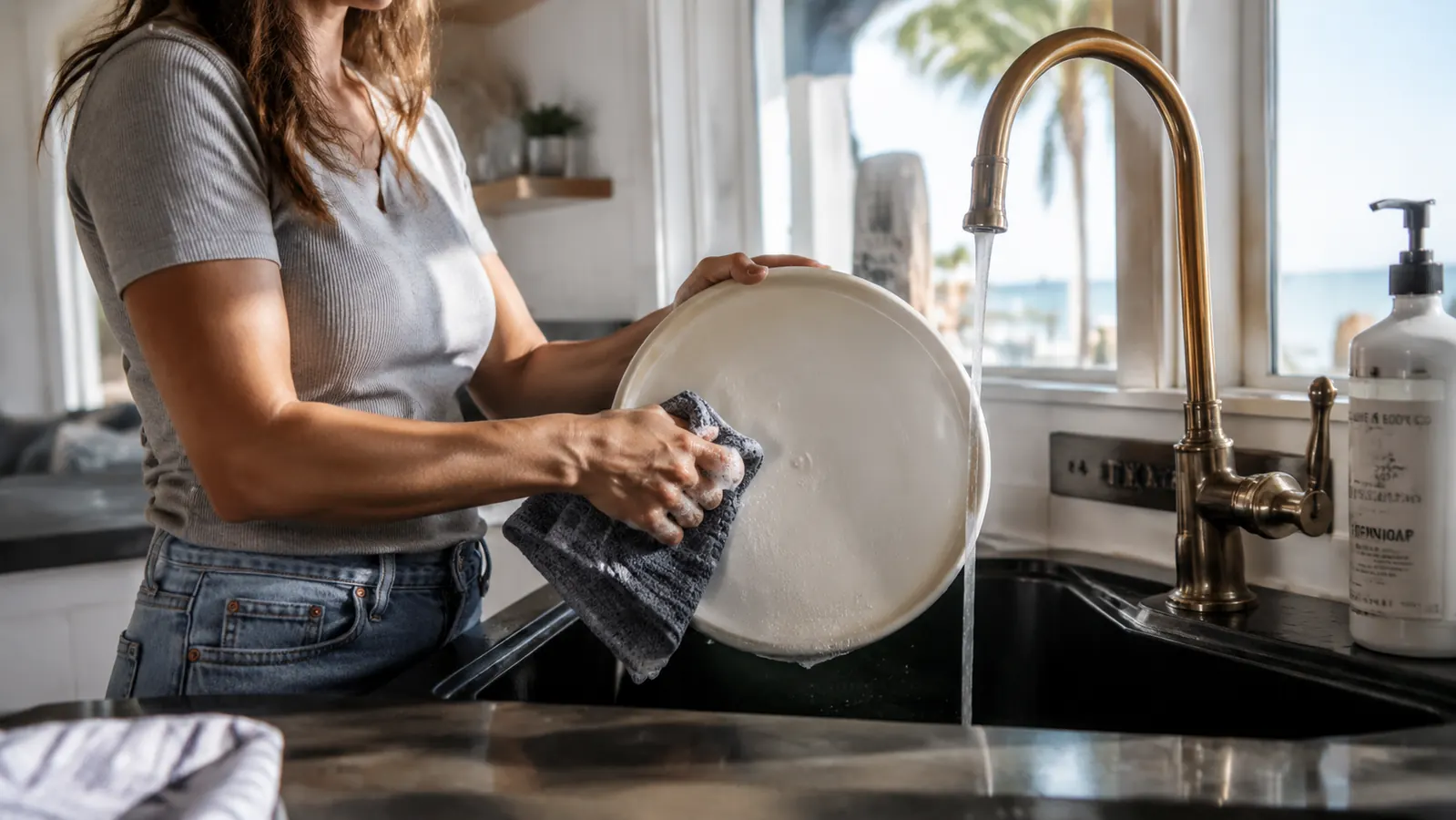
This is the detail that would have annoyed me most if I hadn't caught it in the manual. The dipping plate and base are not dishwasher safe, full stop. Everything gets hand-washed, every single time, which for us means a quick wipe with a damp cloth most Sundays since the surface releases pretty cleanly, but every third or fourth use I do need actual soap and warm water to get rid of a light film that builds up.
If dishwasher convenience matters to you, and in our house it usually does after a big brunch with dishes piling up from six people, this is one more thing sitting by the sink instead of going straight into the machine with everything else. It's a small thing on its own, but it adds up over twenty Sundays, and it's the kind of detail that never shows up in the bullet points on the product page.
The cord and base have held up fine with no issues, and I'm not trying to make this sound worse than it is. It's a five-minute job most mornings. I just think you should know going in that you're committing to hand-washing a piece of kitchen equipment permanently, not for a break-in period.
Six Months Later, Here's What Actually Changed
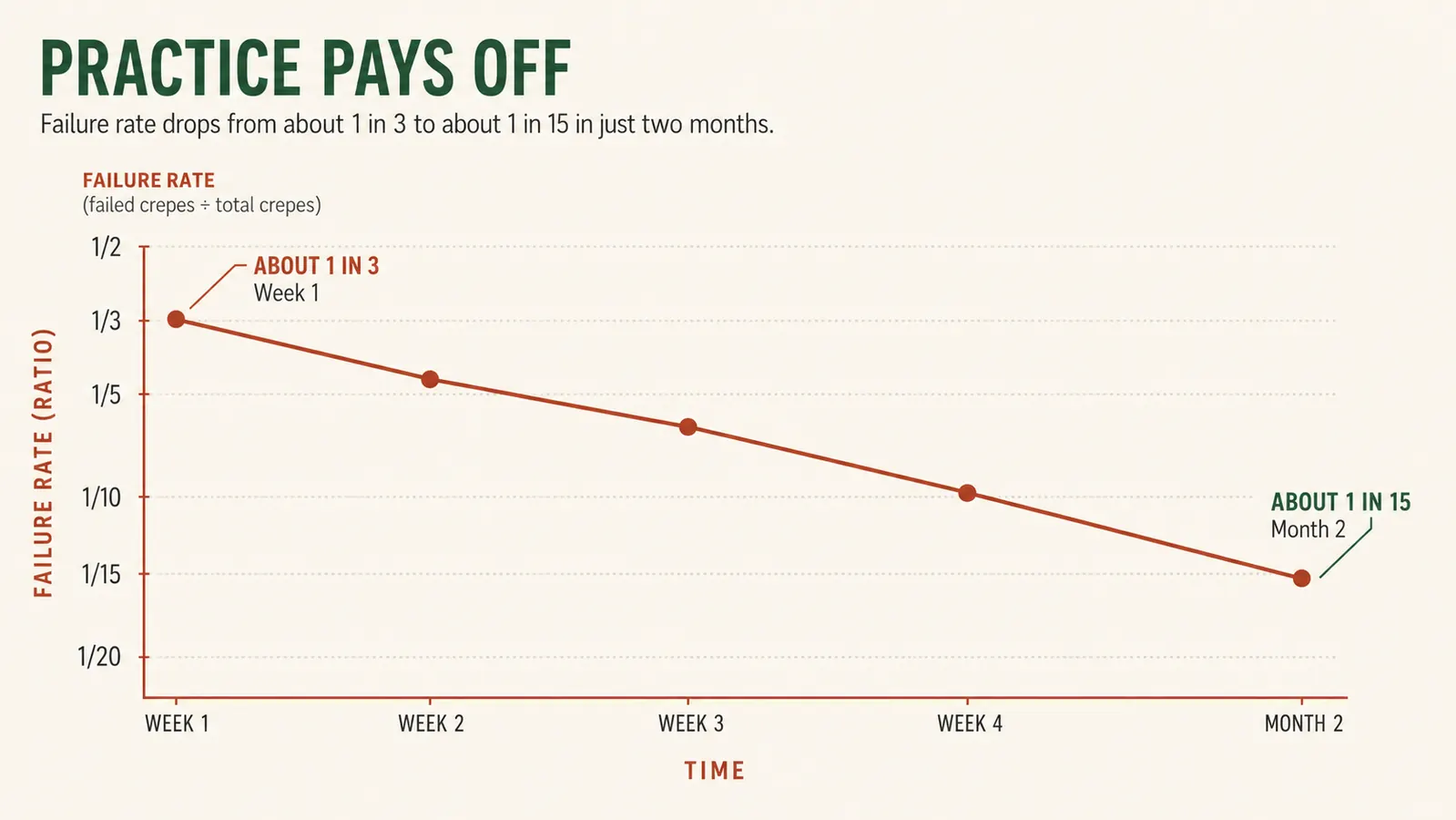
The rough patch I've described mostly lives in the first two or three weeks. By month two, my ratio of good crepes to tossed ones had flipped from roughly one in three failures to maybe one in fifteen, and by month four I'd stopped thinking about the technique at all, it just happens the same way tying a shoe does. That's worth saying plainly, because I don't want the honest parts of this review to scare off someone who'd actually enjoy this machine once they're past the learning curve.
What hasn't changed is the fixed heat and the hand-washing. Those aren't breaking-in problems that improve with time, they're permanent characteristics of how this thing is built. If either one bothers you reading this today, it'll still bother you in month six, because I can tell you from experience it doesn't get better, only more familiar.
The nonstick surface has held up reasonably well across those twenty-some sessions, though it's not quite as forgiving as it was fresh out of the box. I've had a slightly stickier morning here and there where a crepe needed a little coaxing at the edge with the wooden spreader that came with it. Nothing dramatic, just a gradual softening of how easy that release really is.
What I Liked
- Once you learn the dipping motion, crepes come out thin and even every time
- Simple single switch means nothing to break or malfunction over time
- Compact enough to store on a pantry shelf between uses
- Handles a big family batch without slowing down or overheating
Where It Falls Short
- No temperature control at all, so it's crepes and thin batters only
- The dipping technique has a genuinely rough learning curve, expect a dozen or more practice crepes
- Hand-wash only, no dishwasher, forever
- Preheat time runs longer than the manual claims, and the first crepe of any batch is usually a throwaway
Nobody puts 'expect to ruin your first dozen crepes' on the product listing, but that's the honest starting point with this thing.
Who This Is For
This is a good fit if you're the type who doesn't mind a short, mildly annoying learning curve in exchange for a reliable result on the other side of it. If you've got a family that actually wants crepes on a regular basis, not just once a year, the few rough Sundays it takes to get the motion down pay for themselves fast. It's also a solid pick if hand-washing one extra item isn't a dealbreaker for your kitchen routine, and if you'd rather adjust your own batter recipe than rely on the one printed in the box.
Who Should Skip It
If you want a gadget that works perfectly the very first time you plug it in, this isn't that. It genuinely takes practice, and if you're not willing to burn through a few less-than-perfect crepes while you figure out the dip, you'll end up frustrated and it'll end up in a cabinet. Skip it too if you were hoping for one machine that handles eggs, thick pancakes, or anything beyond thin batters, since the lack of a temperature dial rules that out. And if dishwasher-safe is a hard requirement in your house, look elsewhere, because this one will always be a hand-wash item.
Know What You're Getting Into Before You Buy
If a short learning curve and hand-washing one extra pan don't scare you off, this crepe maker earns its spot on the counter fast. Check today's price on Amazon and decide for yourself.
Amazon Check Today's Price on Amazon →